Bill & rule tracker
Follow proposals from introduction through amendment, vote, signature, regulation, and enforcement.
Reads visible page information. Voice choices depend on your device; choosing a voice does not translate the text.
 Recycling Policy & IndustrySearch • Policy • Industry • Action
California first · United States next · Global future
A trusted intelligence, policy, legislation, and advocacy platform for recyclers, processors, scrap yards, companies, communities, agencies, legislators, and senators.
Recycling intelligence search
CRV resources are live today. New material hubs are marked clearly as they are researched, verified, and added.
Current bill status, deadlines, operational impact, and recommended action for the CRV industry.
Verified status and plain-language analysis of AB 2253, AB 762, AB 1604 and SB 881 as the measures move through the final legislative phase.
A practical framework for statewide cost recovery, remote access, new-site support, and public results.
Permanent centers, mobile units, kiosks, bag drop, built-in retail space, and consumer-access concepts.
Commitments covering integrity, clean material, transparent payment, reporting, access, and training.
A policy vision for focused authorities, protected program funds, shared services, and public dashboards.
One industry · many material systems
Each hub will connect legislation, regulation, grants, operations, markets, technology, advocacy, and practical compliance.
Deposits, redemption access, recyclers, processors, payments, fraud prevention, and infrastructure.
Explore hub →Ferrous and nonferrous markets, permits, scale practices, theft prevention, safety, and compliance.
Explore hub →Hauling, manifests, cleanup, grants, market development, reuse, and end-of-life policy.
Explore hub →Collection, stewardship, transport, lithium safety, lead-acid recovery, and producer responsibility.
Explore hub →Certified collection, payments, filters, antifreeze, contamination, transport, and enforcement.
Explore hub →Collection, composting, edible-food recovery, methane reduction, infrastructure, and local rules.
Explore hub →Dismantling, titles, fluids, parts reuse, batteries, catalytic converters, tires, and end-of-life vehicles.
Explore hub →Packaging, electronics, paint, carpet, mattresses, textiles, stewardship plans, and recycled content.
Explore hub →Build the industry’s knowledge infrastructure
The platform begins with deep California CRV knowledge, then expands across materials, jurisdictions, and global recycling markets without mixing proposals with confirmed requirements.
Follow proposals from introduction through amendment, vote, signature, regulation, and enforcement.
Search by material, jurisdiction, program, agency, deadline, compliance question, or operating need.
Turn verified information into briefings, support letters, testimony, coalition outreach, and meeting materials.
Connect policy to permits, payments, grants, safety, technology, markets, reporting, and real-world operations.
CRV policy, operations, visual briefings, and weekly intelligence.
State-by-state bills, programs, compliance, markets, and industry network.
International policy, technology, commodity, circular-economy, and market intelligence.
Thursday CRV Weekly · September 24, 2026
SB 955 is effective; SB 633 and AB 2481 generally take effect January 1, 2027.
Governor action changed the operating-law status after the September 17 edition.
Does it affect me? RVMs no longer make an unserved zone served, cannot displace specified mobile/co-op access or existing-center handling-fee eligibility, and the handling-fee methodology authority now runs through June 30, 2032.
What do I need to do? Review convenience-zone, RVM and handling-fee decisions against the enacted text; retain current CalRecycle rate and claim instructions unless the department issues implementation guidance.
Official status ↗Official text ↗Does it affect me? It raises a recycled-content penalty to $0.30 per pound and adds third-party validation and public compliance reporting beginning in 2028. It principally affects beverage manufacturers, reclaimers and recycled-plastic manufacturers.
What do I need to do? Covered manufacturers and plastics-market participants should map the March 1, 2028 validation/reporting requirements; redemption-counter procedures do not change now.
Official status ↗Official text ↗Does it affect me? After primary glass quality payments, CalRecycle may use remaining annual funds for qualifying clean CRV glass used in California non-container glass products, up to $30 per ton.
What do I need to do? Certified entities should await CalRecycle eligibility and claim guidance before booking revenue; preserve contamination and end-market records.
Official status ↗Official text ↗Does it affect me? The proposed 12-cent bag-in-box cap concerns manufacturer processing fees, not consumer CRV or recycler payments.
What do I need to do? Do not treat the proposal as law; monitor official action through September 30.
Official status ↗Official text ↗CalRecycle notice · September 16
Revised July 1, 2026–June 30, 2027 tiers reach $250 per ton for qualifying PET beverage-container uses and PET reclaimer claims. Q3 2026 claims are due November 10; incomplete eligibility forms will stop processing.
Comparable snapshot · September 24
CalRecycle displayed “1–10 of 1,312 items” with Recyclers selected, Processors unselected and All Counties. The same scope showed 1,310 on September 17, a net increase of two listings.
SB 955 · effective September 18
A certified RVM does not by itself make an unserved zone served, does not bar specified mobile units or dealer cooperatives from program payments, and does not make an existing certified center ineligible for handling fees solely because the RVM is in the same zone.
Material retailer development
The chaptered law raises the statutory supermarket sales threshold to $6 million and clarifies the role of certified RVMs. This site treats CGA as an industry partner and source while using the enacted text and CalRecycle records for legal status.
Chaptering is confirmed only where the official Legislature record says so. “No material change identified” is limited to the public records reviewed. The directory measures listed certifications, not real-time customer access.
Do not treat legislative passage as enactment.
Still with the Governor; presented September 10. Not enacted as of the September 24 review.
Official status ↗Still with the Governor; presented September 3. Not enacted as of the September 24 review.
Official status ↗No verified outbound email connection and verified active-recipient list are available. This is copy, not a delivery confirmation.
What changed? SB 955 was signed and chaptered September 18 as an urgency statute and is effective immediately. SB 633 was chaptered September 18 and AB 2481 on September 20; both are non-urgency measures that generally take effect January 1, 2027.
Does it affect me? SB 955 immediately changes the legal treatment of certified RVMs in convenience zones and protects specified existing-center handling-fee eligibility. AB 2481 may expand downstream glass quality payments after implementation. SB 633 principally affects beverage manufacturers and plastics-market participants.
PMDP participants: CalRecycle now requires a completed Form 910 PMD3 with every claim. Revised July 1, 2026–June 30, 2027 tiers apply beginning with Q3 2026 claims due November 10. Incomplete claims will not be processed.
Center watch: CalRecycle's statewide directory displayed 1,312 recycler-program listings on September 24 with Recyclers selected, Processors unselected and All Counties—two more than the comparable September 17 snapshot. This net listing change does not establish two openings, and 1,312 is not a verified count of open walk-in centers.
What do I need to do? Review SB 955 operations now; PMDP participants should use Form 910 PMD3 and prepare the November 10 claim; implement Q4 processing-payment rates October 1; monitor remaining Governor actions through September 30; and prepare city/county funding requests due November 17.
CGA & Retailer Update: SB 955 is the material retailer development. The chaptered law raises the statutory supermarket sales threshold to $6 million and clarifies the role of certified RVMs. Retailers should verify DReaMS information, zone notices, signs and current service arrangements against the enacted text and CalRecycle guidance.
No other material change was identified in the reviewed official sources for the payable handling-fee rate or cost study, bag-drop rules, RIG openings, permanent wine-and-spirits regulations, general enforcement controls or routine processor reporting deadlines.
Primary sources: SB 955 ↗ SB 633 ↗ AB 2481 ↗ SB 1341 ↗ · PMDP notice ↗ · certified-program directory ↗
Thursday CRV Weekly · September 17, 2026
Processing payments are not consumer refunds or handling fees.
The adjusted rates take effect October 1, 2026.
Processing payment · per pound
Glass increases 0.52% and HDPE 4.80% from the July 1 schedule. PET is unchanged. CalRecycle also lists Q4 rates for Vinyl, LDPE, PP, PS, Other, Bimetal and wine/distilled-spirits packaging categories.
Comparable snapshot · September 17
CalRecycle’s directory displayed “1–10 of 1,310 items” with Recyclers selected, Processors unselected and All Counties. The September 12 snapshot used the same scope and also showed 1,310, for a net listing change of zero.
Does it affect me? RVM coexistence and handling-fee provisions remain proposed—not current operating law.
What do I need to do? Continue current rules and monitor signature or veto through September 30.
Official status ↗Official text ↗Does it affect me? The proposed 12-cent bag-in-box cap concerns manufacturer processing fees, not consumer CRV or recycler payments.
What do I need to do? Do not change payments unless the measure is enacted and implemented.
Official status ↗Official text ↗Does it affect me? The recycled-content measure remains relevant primarily to manufacturers and processors.
What do I need to do? Monitor Governor action; do not treat passage as enactment.
Official status ↗Official text ↗Does it affect me? The glass quality-incentive proposal could affect downstream markets if enacted.
What do I need to do? Do not anticipate payment changes before enactment and implementation.
Official status ↗Official text ↗Prepare before October 1
Confirm material classification, eligible shipment dates and processor/recycler records against the official attachment. Retain the notice with staff instructions and investigate any statement that uses the wrong quarter.
Continuing opportunity · due November 17
CalRecycle lists $10.5 million for FY 2026–27 beverage-container recycling and litter cleanup. Eligible applicants are California cities and counties; private operators may explore eligible local partnerships.
Pending bills remain proposals until official records show approval and chaptering. “No material change identified” is limited to the public records reviewed. The directory count measures listed certifications, not real-time availability.
AB 2253 reached the Governor September 10; passage does not equal enactment.
Presented to the Governor September 10 at 3 p.m.; no signature or chapter posted.
Official status ↗Presented to the Governor September 3 at 4 p.m.; no signature or chapter posted.
Official status ↗No verified outbound email connection is available. This is copy for the consenting subscriber audience, not a delivery confirmation.
What changed? CalRecycle's September 15 notice increases fourth-quarter 2026 processing payments effective October 1: glass rises to $0.12921 per pound and HDPE to $0.67721 per pound. PET remains $0.33862 per pound. The notice also lists current rates for other eligible material types.
Does it affect me? Certified recyclers and processors should use the October 1 schedule for qualifying shipments and reporting. These processing payments are separate from consumer CRV refunds and handling fees.
Center watch: CalRecycle's statewide directory displayed 1,310 recycler-program listings on September 17 with Recyclers selected, Processors unselected and All Counties. That is unchanged from the comparable September 12 snapshot. It is not a verified count of centers open and accepting walk-in CRV today.
What do I need to do? Update October settlement and reconciliation references; confirm material classification and shipment dates; keep current customer refunds unchanged; monitor Governor action through September 30; and remind eligible cities and counties that funding requests are due November 17.
No material change was identified in the reviewed official sources for handling fees or cost studies, mobile/bag-drop requirements, RIG openings, wine-and-spirits regulations, general enforcement standards or routine reporting deadlines.
Primary sources: Q4 processing payments ↗ · certified-program directory ↗ · SB 955 ↗ SB 1341 ↗ SB 633 ↗ AB 2481 ↗ · city/county funding ↗
Thursday CRV Weekly · September 10, 2026
Current operating rules remain in place. Pending bills are not enacted law.
Initial estimates may be adjusted; this is not a change to consumer CRV.
Statewide weighted averages · per ton
Bimetal was $3.91 per ton. These processor-reported values are initial estimates subject to adjustment.
Does it affect me? RVM coexistence and handling-fee provisions remain proposed—not current operating law.
What do I need to do? Continue current rules and monitor signature or veto through September 30.
Official status ↗Official text ↗Does it affect me? The proposed 12-cent bag-in-box cap concerns manufacturer processing fees, not consumer CRV or recycler payments.
What do I need to do? Do not change payments unless the measure is enacted and implemented.
Official status ↗Official text ↗Does it affect me? The recycled-content measure remains relevant primarily to manufacturers and processors.
What do I need to do? Monitor Governor action; do not treat passage as enactment.
Official status ↗Official text ↗Does it affect me? The glass quality-incentive proposal could affect downstream markets if enacted.
What do I need to do? Do not anticipate payment changes before enactment and implementation.
Official status ↗Official text ↗Grant follow-up · due today
The FY 2026–27 / 2027–28 Beverage Container Recycling Grant application period closed August 11. Existing applicants have until September 10, 2026 to upload required authorizations not already supplied and adopt an environmentally preferable purchasing policy if missing at application. This is not a reopening and is separate from RIG.
Continuing opportunity · opened August 19
CalRecycle lists $10.5 million for FY 2026–27 beverage-container recycling and litter cleanup. Eligible applicants are California cities and counties. This is a potential local-government partnership opportunity, not a direct grant award or operating subsidy for private redemption centers.
September 30 applies to bills passed before September 1 and in the Governor’s possession on or after September 1. This briefing is an industry summary, not an agency directive. “No material change identified” is limited to the public records reviewed.
Completed legislative passage does not mean a bill has become law.
Presented to the Governor September 3 at 4 p.m.; no signature posted.
Official status ↗Enrollment is dated September 3; no presentation or enactment is posted.
Official status ↗No verified outbound email connection is available. This is copy for the consenting subscriber audience, not a delivery confirmation.
What changed? CalRecycle posted July 2026 statewide average scrap values on September 3: aluminum $1,700.00 per ton, glass negative $1.19, bimetal $3.91, PET $175.18 and HDPE $439.19. These are initial processor-reported estimates and may be adjusted.
Does it affect me? This market notice does not itself change consumer CRV refund amounts or the published handling-fee rate. Centers should reconcile processor statements and material economics without changing statutory customer refunds.
What do I need to do? Existing Beverage Container Recycling Grant applicants must upload missing authorization documents and adopt any outstanding EPPP by September 10. The application period is closed. Monitor Governor action through September 30.
No material change was identified for handling fees or cost studies, Q3 processing payments, mobile/bag-drop requirements, RIG openings, wine/spirits regulations, general processor/enforcement standards or routine reporting deadlines.
Primary sources: SB 955 ↗ SB 1341 ↗ SB 633 ↗ · September 10 deadline ↗ · City/county funding ↗ · Unlabeled-container guidance ↗
Thursday CRV Weekly · September 3, 2026
Latest posted actions appear below. Current operating rules remain in place; proposals and platform advocacy are separate.
None of the measures below is confirmed as enacted in the official records reviewed.
Does it affect me? Proposed RVM coexistence protections and handling-fee methodology through June 30, 2032 could affect centers and retailers. They are not current requirements.
What do I need to do? Monitor signature or veto; continue current eligibility rules. This bill does not authorize the platform’s separate multi-location RC proposal.
Official status ↗Official text ↗Does it affect me? The proposed 12-cent bag-in-box cap concerns manufacturer processing fees—not consumer CRV or a cap on recycler processing payments.
What do I need to do? Use current CalRecycle notices, not the proposed cap, for operating decisions.
Official status ↗Official text ↗Does it affect me? Manufacturers and processors should follow the plastic beverage-container and recycled-content proposal.
What do I need to do? Watch Governor action and any eventual implementation dates before treating it as law.
Official status ↗Official text ↗Does it affect me? The proposal concerns glass quality incentive payments.
What do I need to do? Processors should review potential changes, but continue current program requirements pending enactment and implementation.
Official status ↗Official text ↗Grant follow-up · one week remaining
The FY 2026–27 / 2027–28 Beverage Container Recycling Grant application period closed August 11. Existing applicants have until September 10, 2026 to upload required authorizations not already supplied and adopt an environmentally preferable purchasing policy if missing at application. This is not a reopening and is separate from RIG.
Continuing opportunity · opened August 19
CalRecycle lists $10.5 million for FY 2026–27 beverage-container recycling and litter cleanup. Eligible applicants are California cities and counties. This is a potential local-government partnership opportunity, not a direct grant award or operating subsidy for private redemption centers.
September 30 applies to bills passed before September 1 and in the Governor’s possession on or after September 1. This briefing is an industry summary, not an agency directive. “No material change identified” is limited to the public records reviewed.
Completed legislative passage does not mean a bill has become law.
Assembly concurrence August 30; ordered engrossed and enrolled. No enactment confirmed in the history reviewed.
Official status ↗Passed Legislature; enrollment dated August 30. No presentation or signature posted in the status reviewed.
Official status ↗No verified outbound email connection is available. This is copy for the consenting subscriber audience, not a delivery confirmation.
What changed? SB 955 was presented to the Governor September 2, SB 633 on August 31 and AB 2481 on August 28. SB 1341 is enrolled, without presentation posted in the record reviewed. None is confirmed as enacted as of this September 3 review.
Does it affect me? These proposals concern RVM coexistence, handling-fee methodology, manufacturer processing fees, recycled content and glass quality incentives. The SB 1341 proposed 12-cent cap is not consumer CRV or a recycler-payment cap. Current operating rules still apply.
What do I need to do? Existing Beverage Container Recycling Grant applicants should complete outstanding authorization documents and any missing EPPP adoption by September 10. This is not a reopened application window or a RIG deadline. September 30 is the Governor-action deadline for qualifying bills; city/county funding requests are due November 17.
No material change was identified in reviewed public sources for handling-fee rates/cost studies, Q3 processing payments, mobile/bag-drop rules, RIG openings, general processor/enforcement requirements or routine reporting deadlines. Facility-specific notices still apply.
Read the full briefing for official sources and the distinction between permanent unlabeled-container exemptions and the separately supplied August 18 transition memorandum. December 31 is not a universal container-rejection date.
Primary sources: SB 955 ↗ SB 1341 ↗ SB 633 ↗ · September 10 deadline ↗ · City/county funding ↗ · Unlabeled-container guidance ↗
Thursday CRV Weekly · August 27, 2026
Records checked August 27. The latest posted action dates are shown below; later same-day votes may change status. Recommendations and platform advocacy are labeled separately.
None of the measures below is confirmed as enacted in the official records reviewed.
Would extend the handling-fee methodology through June 30, 2032, preserve specified existing-center eligibility and prevent an RVM alone from making an unserved zone served.
Recommended action: Platform advocacy position: SUPPORT final passage. Implementation safeguards are recommendations, not conditions of support. Do not treat the extension as enacted.
Official status ↗Official text ↗Would cap the manufacturer processing fee for qualifying bag-in-box containers at $0.12. This is not a cap on consumer CRV or recycler processing payments. The text preserves cost surveys and provides for full processing payments subject to fund availability.
Recommended action: Track concurrence and Governor action; keep current payment schedules until legally changed.
Official status ↗Official text ↗Would strengthen plastic recycled-content validation and penalties. Third-party validation reporting would begin by March 1, 2028, if enacted; this is principally a manufacturer obligation.
Recommended action: Monitor enrollment and Governor action. No new redemption-counter rule is in effect from this bill.
Official status ↗Official text ↗Glass quality-incentive proposal; potential downstream-market benefit, not a guaranteed new payment to every redemption center.
Recommended action: Continue the August 26 news follow-up: watch Governor action and implementation; do not book proposed revenue.
Official status ↗Official text ↗Grant follow-up · newly highlighted, not a new CRV mandate
The FY 2026–27 / 2027–28 Beverage Container Recycling Grant application period closed August 11. Existing applicants have until September 10, 2026 to upload required authorizations not already supplied and adopt an environmentally preferable purchasing policy if missing at application. This is not a reopening and is separate from RIG.
Opened August 19 · omitted from last week’s briefing
CalRecycle lists $10.5 million for FY 2026–27 beverage-container recycling and litter cleanup. Eligible applicants are California cities and counties. This is a potential local-government partnership opportunity, not a direct grant award or operating subsidy for private redemption centers.
September 30 applies to bills passed before September 1 and in the Governor’s possession on or after September 1. This briefing is an industry summary, not an agency directive. “No material change identified” is limited to the public records reviewed.
Completed legislative passage does not mean a bill has become law.
Amended August 21; returned to Senate third reading August 24. Floor vote still pending.
Official status ↗Completed legislative passage August 26; ordered to engrossing and enrolling. Not yet law.
Official status ↗Completed legislative passage August 26; ordered to engrossing and enrolling. Not yet law.
Official status ↗Presented to the Governor August 24 at 3 p.m.; no signature or chapter posted in the record reviewed.
Official status ↗No verified outbound email connection is available. This is copy for the consenting subscriber audience, not a delivery confirmation.
This week’s material changes are legislative progress—not new enacted CRV operating rules. SB 955 passed the Assembly August 24 and reached the Senate special consent calendar August 26, with concurrence pending. SB 1341 passed the Assembly August 25 and also awaits Senate concurrence. SB 633 completed legislative passage August 26. None is confirmed as law in the official records reviewed.
SB 955 would extend the handling-fee methodology through June 30, 2032 and protect specified existing-center eligibility. Our platform supports final passage without conditions; implementation safeguards remain separate recommendations. SB 1341’s proposed $0.12 bag-in-box cap concerns manufacturer processing fees, not consumer CRV or a cap on recycler payments.
Action dates: August 31 is the legislative passage deadline. Existing Beverage Container Recycling Grant applicants should complete required authorization documents and any outstanding environmentally preferable purchasing policy by September 10. The city/county payment program opened August 19, with requests due November 17; operators may explore partnerships, but cities and counties—not private operators—are the applicants.
No material change was identified in the public sources reviewed for handling fees/cost studies, mobile or bag-drop operating rules, RIG openings, processor/enforcement standards or routine reporting deadlines. The July 1 handling fee remains $0.01289 per eligible container. No new Q4 processing-payment notice was identified.
Keep last week’s August 18 memo in staff instructions, but do not treat December 31 as a blanket cutoff for every unlabeled container. CalRecycle’s public guidance separately preserves qualifying older filled-and-labeled wine/spirits and large-juice containers. The memo’s December 31 transition statement is carried forward from the copy supplied to the platform; a public copy was not independently located this week.
Broader watch: AB 762 and AB 1604 completed legislative passage August 26; AB 2253 remains on the Senate floor; SB 881 was presented to the Governor August 24. These measures are not yet confirmed as law. Read the complete dated briefing and direct official links at https://california-crv-policy.alkanan.chatgpt.site/crv#weekly-update.
Primary sources: SB 955 ↗ SB 1341 ↗ SB 633 ↗ · September 10 deadline ↗ · City/county funding ↗ · Unlabeled-container guidance ↗
Preserved as published. Consult the current briefing above and the policy tracker for later bill statuses and source-verification notes; do not use this archive as current guidance.
Archived Thursday CRV Weekly · August 20, 2026
Separate confirmed operating requirements from pending legislation. The redemption guidance below is effective; the three bills remain proposals.
CalRecycle Division of Recycling memorandum · August 18, 2026
Certified and registered operators should redeem CRV-eligible wine and distilled-spirit containers and 100% fruit juice containers of 46 ounces or more and vegetable juice containers over 16 ounces, whether labeled or not, through December 31, 2026 when the customer indicates an unlabeled container was purchased in California before July 1, 2026.
Official status checked August 20, 2026. No final floor vote was posted at the time of this update.
Would protect existing handling-fee eligibility when a reverse vending machine enters the same convenience zone, allow mobile units and dealer cooperatives alongside RVMs, and extend the handling-fee methodology through June 30, 2032.
Official bill statusWould cap the processing fee for qualifying bag-in-box beverage containers at 12 cents per container and provide funding flexibility for related processing payments.
Official bill statusWould strengthen recycled-content accountability by increasing certain penalties and requiring third-party validation and public manufacturer compliance information beginning in 2028.
Official bill statusFeatured visual policy library
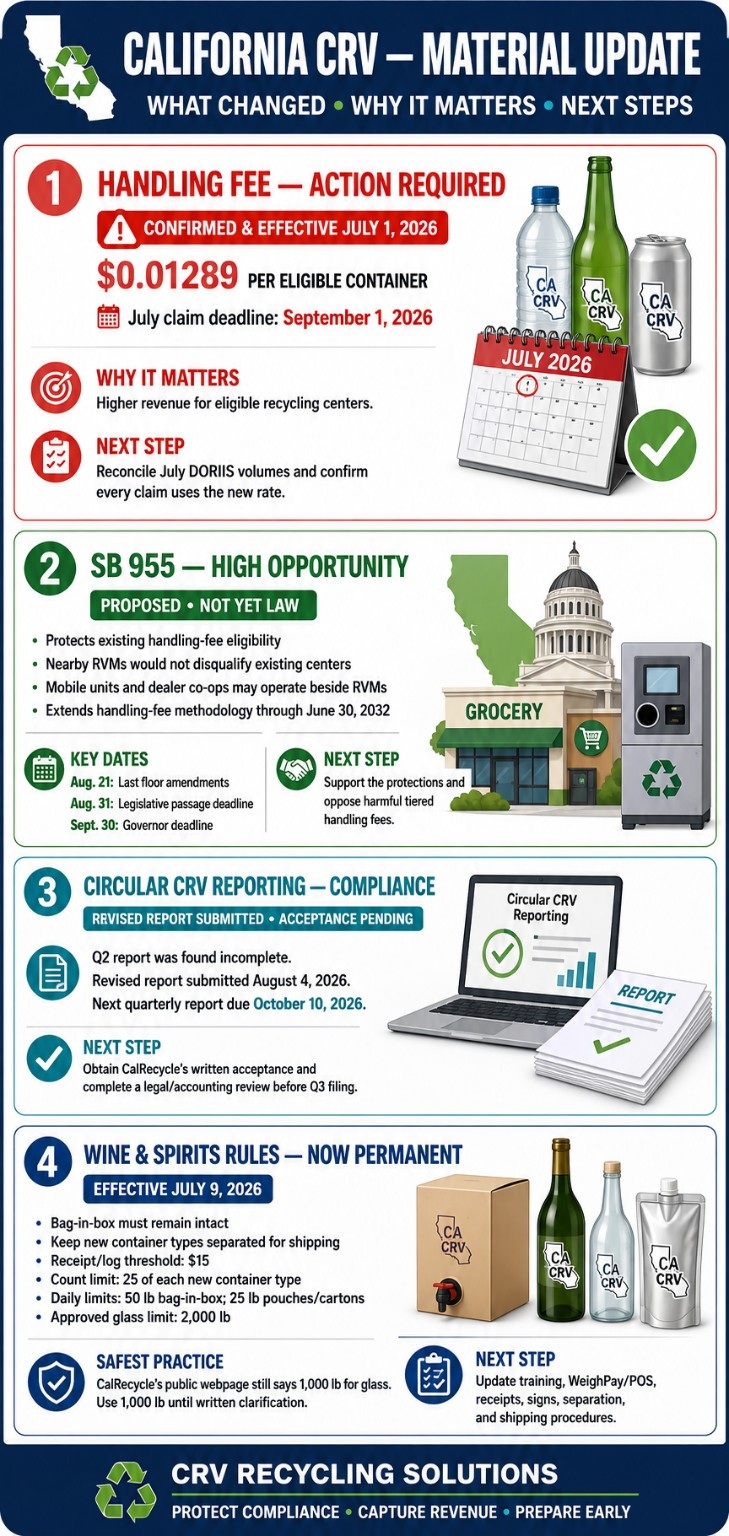
A time-sensitive operational briefing covering the July 2026 handling fee, SB 955, Circular CRV reporting, and permanent wine-and-spirits rules. Legislative status and filing deadlines should be confirmed before later external use.
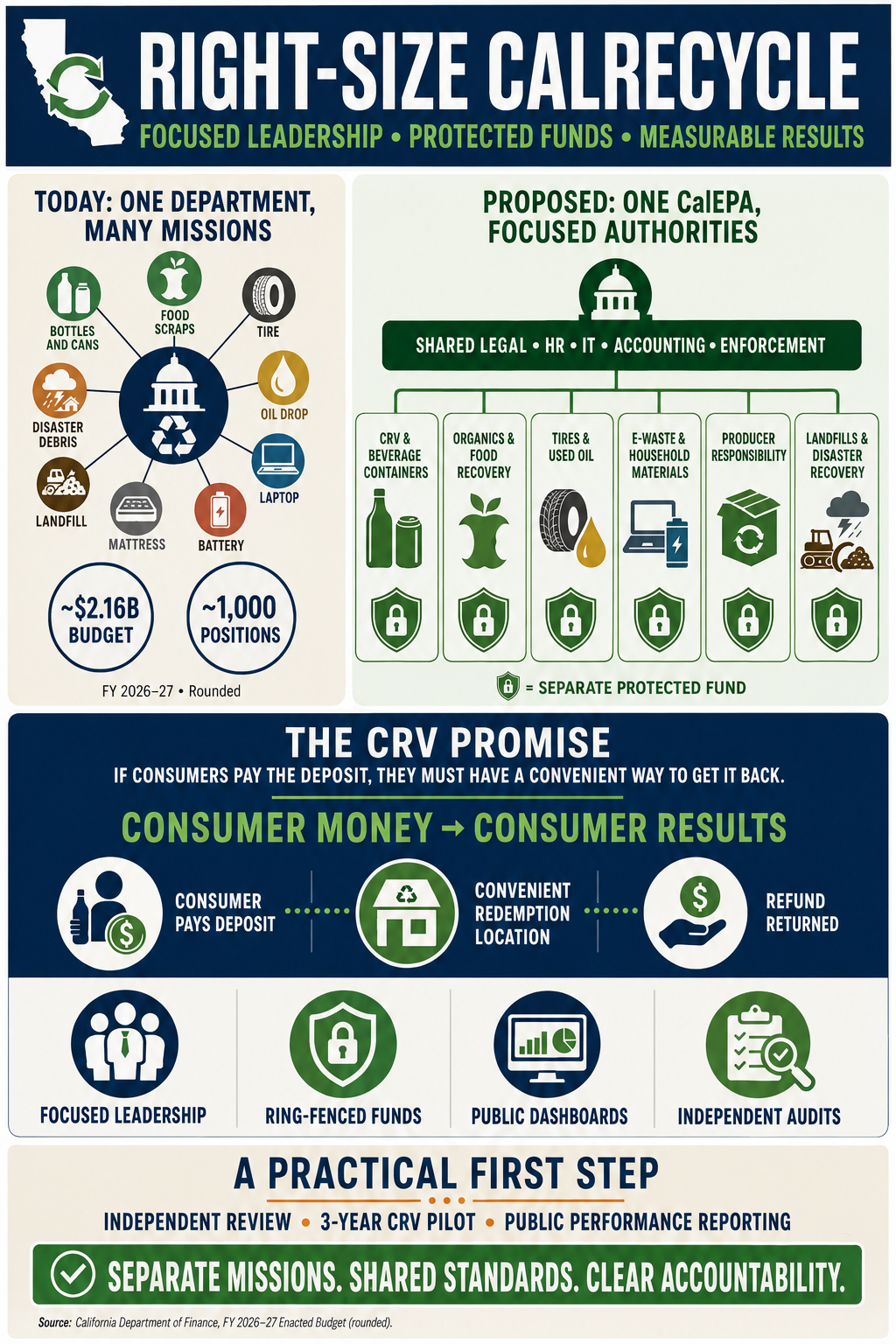
01 · Department structure
Keep one coordinated CalEPA umbrella and shared administrative services, while giving each major recycling mission focused leadership, separately identified funding, and measurable outcomes.
CalRecycle manages programs with very different customers, funding systems, technologies, markets, and legal obligations. The reform goal is specialization and accountability—not adding unnecessary bureaucracy.
Rounded figures from the California Department of Finance 2026–27 enacted budget. The beverage-fund balance is restricted program money, not unrestricted government profit.
CRV resources should first support refunds, convenient redemption, infrastructure, processing capacity, market stability, and program integrity. Any unrelated transfer should require public disclosure, legislative authorization, and a defined repayment schedule.
Measure consumer access, recycling rates, payment timeliness, infrastructure delivery, administrative cost, fund performance, and stakeholder satisfaction before considering a broader reorganization.
02 · Fund the outcome
These proposed benchmarks align operator support with the public outcome California expects: more convenient, compliant redemption.
A clear, predictable statewide floor tied to the real cost of convenient redemption.
Additional support when distance and route density make service materially more expensive.
$0.025 urban and $0.030 rural incentive for the first 300,000 containers during launch.
Use transparent operating data to set support that reflects the real cost of compliant redemption across California.
What Californians want
Convenient options in urban, rural, and underserved areas.
Clear rates and accurate CRV redemption value.
Fast, respectful, understandable customer experience.
Less litter, more recycling, and accountable public spending.
03 · Explore the agenda
Select a lens to see how the recommendations connect funding, access, program integrity, and modernization.
Every program dollar should be traceable to better access, higher participation, reliable service, or stronger program integrity.
04 · Future CRV infrastructure
Explore mobile, modular, solar-powered, and retail-ready concepts designed to bring cleaner, safer, and more convenient CRV redemption closer to California consumers.
This gallery includes operational photography and concept visualizations for planning and policy discussion. Concept images do not necessarily represent current operating locations.
05 · Earn public trust
Public support must be matched by a clear operating standard— verified material, responsible service, accurate data, and continuous improvement.
Eligibility checks and rejection of ineligible material
Required identity, vehicle, load, and red-flag controls
Liquid detection, separation, and contamination control
Clearly posted rates and secure payment options
Accurate weights, payments, shipments, and program data
Respectful service, practical hours, and safe locations
CRV, customer service, safety, and security training
Wait time, uptime, complaints, and corrective actions
06 · Move from policy to practice
A proposed sequence that establishes the data first, deploys targeted support, expands access, and reports outcomes annually.
Publish the cost method, define access gaps, and agree on public measures.
Begin funding reform, remote add-ons, and qualified new-site incentives.
Fast-track practical sites, connect data, and correct service gaps early.
Show access, participation, integrity, quality, and continuity results.
07 · Briefing library
Three concise briefs designed for policymakers, agency staff, processors, retailers, and industry partners.
Funding benchmarks, access reforms, modernization, and transition priorities.
Download PDF ↓The operating standards responsible CRV operators should deliver.
Download PDF ↓A proposed sequence and practical measures for public results.
Download PDF ↓These materials present recommendations for discussion and do not state current California law or agency policy.
Ask the recycling network
CEO, CRV Recycling Solutions
Recycling operator, policy contributor & industry advocate