
Reads visible page information. Voice choices depend on your device; choosing a voice does not translate the text.

Recycling Policy & IndustryRecycling Policy & IndustrySearch • Policy • Industry • Action
Share this pageSend this exact page to a colleague, community member or decision-maker.

Independent policy recommendation

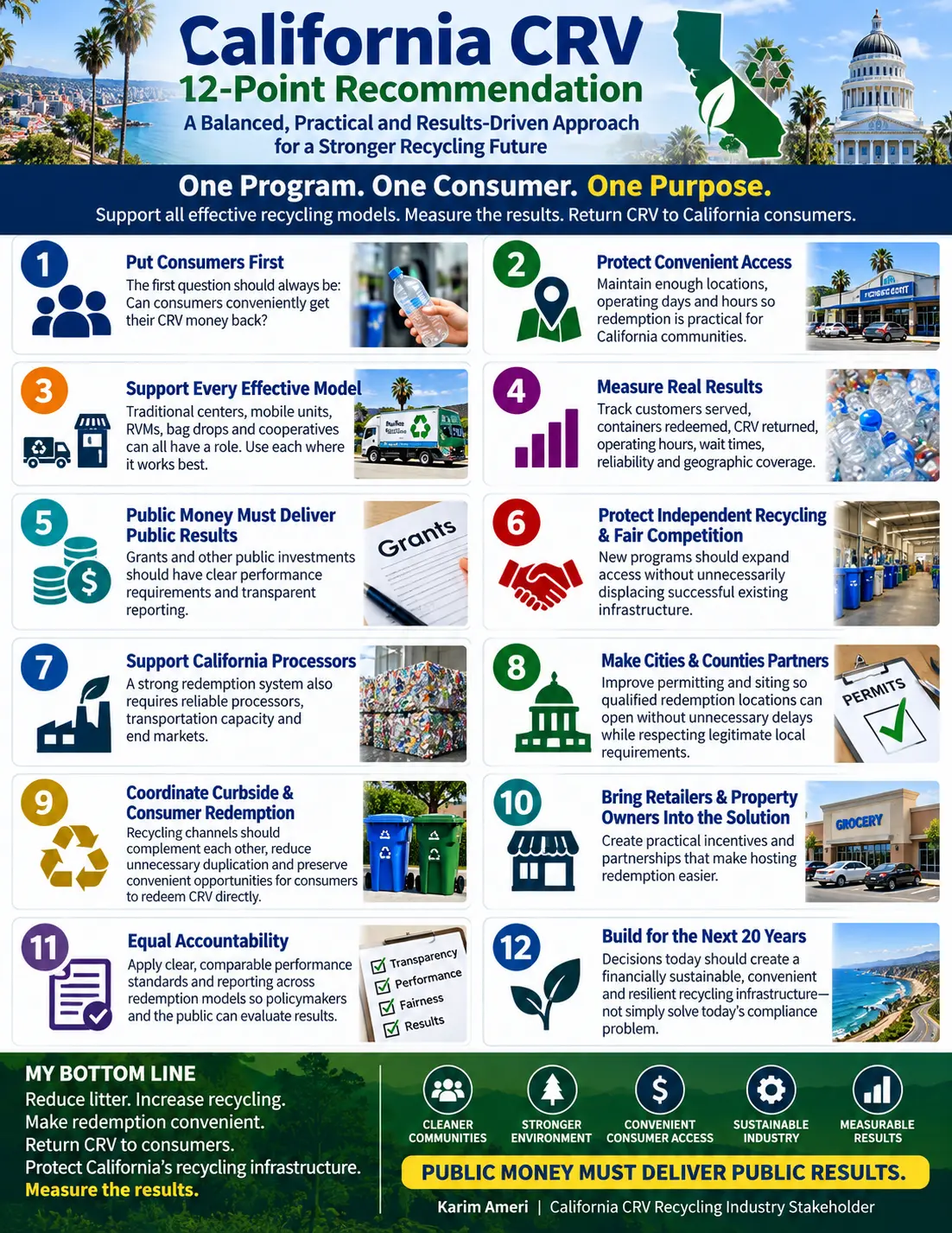
California CRV: a practical 12-point framework

A balanced, results-driven approach designed to improve consumer access, protect effective infrastructure and make every public investment accountable.
Recommendation—not current law.

This framework is an independent policy proposal from Recycling Policy & Industry. It is not an official CalRecycle statement, legal opinion or substitute for current statutes, regulations and agency guidance.

One program. One consumer. One purpose.

Build the system around public outcomes.

The California Redemption Value program should return deposits to consumers conveniently, increase recycling, reduce litter and maintain dependable infrastructure across the state. That requires more than creating programs or certifying locations: California must measure whether service is actually available, reliable and financially sustainable.

This framework does not call for one operator, one technology or one business model. It calls for a common public standard that supports every qualified approach capable of producing verified results.

Public money must deliver public results.
Primary beneficiary
California consumers and communities
Operating principle
Support every effective model; measure all models fairly
Policy objective
Convenient access, accurate refunds and resilient infrastructure

Historical context

Retail redemption has a useful history.

A historical Reynolds can-machine photograph shared by Karim Ameri, together with Resource Recycling’s account of the wider buyback network, illustrates an earlier approach to retailer-hosted redemption. Ameri credits Ralph Alcantar with work on the project; that attribution is based on Ameri’s account and is not independently verified. Ameri says he was not employed by Reynolds or involved in its projects.

Policy takeaway: assess a modern model by consumer access, eligible materials, collection logistics, cost, reliability and refund accuracy. The historic machine alone does not establish current CRV eligibility or performance.

View the photograph, source and historical notes →

The complete framework

Twelve recommendations, with practical meaning and action.

Each point states the principle, explains why it matters and identifies a workable policy action.
01

Put consumers first

The first test of every CRV policy should be whether consumers can conveniently receive the refund value they paid.

Program success should be evaluated from the consumer’s point of view: reasonable travel distance, dependable hours, accurate refunds, accessible service, safe locations and practical payment choices. Administrative compliance is not enough when the public cannot reliably redeem containers.

Recommended actionAdopt statewide consumer-access and refund-accuracy measures, supported by complaint tracking and periodic public reporting.
02

Protect convenient access

Maintain enough redemption capacity, locations, operating days and service hours for California communities.

A listed address does not necessarily provide meaningful access. Access should reflect customer demand, population, transportation options, site capacity, wait times and actual operating reliability—including the needs of rural communities, older adults and people without a vehicle.

Recommended actionMeasure real travel time, operating capacity and service availability—not merely whether a location appears on a list or map.
03

Support every effective model

Traditional centers, mobile units, RVMs, bag drops, cooperatives and other qualified systems can each have a role.

California has different communities, property constraints and material volumes. No single model will perform best everywhere. Policy should be technology-neutral while requiring every model to meet clear standards for access, refund accuracy, safety, reporting and reliability.

Recommended actionAuthorize different service models according to local need and verified performance rather than favoring one technology or business structure.
04

Measure real results

Track the outcomes that show whether the system is genuinely serving the public.

Useful measures include customers served, containers redeemed, refund value returned, operating hours delivered, average wait time, equipment uptime, geographic coverage and unresolved complaints. Consistent measures allow policymakers to compare programs fairly and correct problems early.

Recommended actionPublish comparable, auditable performance data for every publicly supported redemption model.
05

Public money must deliver public results

Grants, incentives and other public investments should produce measurable access, recycling and consumer benefits.

Public funding should be tied to specific deliverables, timelines and reporting requirements. Funding decisions should explain what service will be created, how long it will operate, whom it will serve and how success will be verified after the award.

Recommended actionUse milestone-based agreements, transparent reporting and corrective measures when funded projects do not deliver the promised service.
06

Protect independent recycling and fair competition

New programs should expand access without unnecessarily displacing successful existing infrastructure.

Independent operators provide local knowledge, investment, employment and redemption capacity. Publicly supported pilots and new systems should prioritize genuine service gaps and compete under fair, transparent rules instead of duplicating or undermining locations already delivering reliable access.

Recommended actionRequire non-duplication analysis, fair eligibility standards and documented public need before subsidized expansion into a served area.
07

Support California processors

A dependable redemption network also requires reliable processors, transportation capacity and end markets.

Recycling centers cannot function without timely hauling, accurate settlement, adequate processing capacity and viable markets for clean material. Program decisions should consider the full chain from the consumer transaction through transportation, processing and final recycling.

Recommended actionEvaluate processor capacity, freight conditions, material quality, payment accuracy and regional market access when designing statewide policy.
08

Make cities and counties partners

Qualified locations need clear, timely and workable local permitting and siting pathways.

State redemption goals cannot succeed when local zoning, parking-lot rules or uncertain permit procedures make compliant sites impractical. Local governments should retain legitimate safety and land-use authority while providing objective standards, predictable timelines and clear decisions.

Recommended actionDevelop model siting standards, permit timelines, pre-approved design options and a formal process for resolving conflicts between state access goals and local requirements.
09

Coordinate curbside and consumer redemption

Curbside collection and direct redemption should complement one another rather than operate as disconnected systems.

Curbside service offers convenience, while redemption centers return CRV directly to consumers. California should clearly track material and refund flows, prevent double counting and preserve practical opportunities for residents who choose to redeem containers themselves.

Recommended actionUse transparent material-flow data, coordinated planning and consumer education while protecting direct-redemption access.
10

Bring retailers and property owners into the solution

Practical incentives and partnerships can make hosting redemption service easier and more reliable.

Retailers and property owners influence site availability, utilities, parking, safety and customer access. A workable program should give them clear compliance choices and predictable responsibilities while allowing qualified operators to manage daily recycling operations professionally.

Recommended actionOffer a practical menu of compliant options—including staffed centers, RVMs, mobile service, cooperative service and in-store redemption—with clear cost and liability rules.
11

Require equal accountability

Comparable performance and reporting standards should apply across redemption models.

A fair system evaluates traditional centers, cooperatives, mobile programs, RVMs and bag-drop systems using consistent expectations for hours, uptime, refund delivery, accessibility, data quality, fraud prevention and public service. Different technology should not mean different accountability.

Recommended actionCreate common core standards and publish results in a format that policymakers, operators and the public can compare.
12

Build for the next 20 years

California needs financially sustainable, convenient and resilient infrastructure—not a series of short-term compliance fixes.

Long-term policy should anticipate population growth, changing packaging, technology, market disruptions, emergencies and regional differences. Systems should be interoperable, adaptable and capable of continuing service when one operator, technology or market fails.

Recommended actionRequire long-range capacity planning, periodic independent review, continuity plans and measurable improvement targets.

Implementation standard

Turn the principles into an accountable program.

The framework can be implemented through legislation, rulemaking, grant conditions, pilot requirements and local-state coordination.
  1. Establish a verified baseline.Document existing access, capacity, program costs, customer use and underserved areas before changing the system.
  2. Set comparable measures.Apply common consumer-access, performance, financial and reporting standards to every qualified model.
  3. Test where service is missing.Prioritize pilots and public investment in demonstrated gaps, with protections for effective existing infrastructure.
  4. Publish the results.Provide clear, auditable data that shows what was funded, what was delivered and what consumers received.
  5. Review and improve.Use scheduled independent evaluations to expand what works, correct what fails and update assumptions as conditions change.

Reduce litter. Increase recycling. Make redemption convenient. Return CRV to consumers. Protect California’s recycling infrastructure. Measure the results.

One program. One consumer. One purpose.Prepared by Karim Ameri, Founder of Recycling Policy & Industry and California recycling-industry stakeholder.

Open participation

Add evidence or recommend an improvement.

Share a missing fact, practical solution, implementation concern or alternative. Submissions are reviewed privately before any public use.

For a formal complaint, regulatory comment or legal deadline, submit directly through the responsible agency’s official process. Do not include private account numbers or sensitive information.