 Recycling Policy & IndustrySearch • Policy • Industry • Action
CRV access · public accountability · system resilience
California CRV Dealer Cooperative Watch
A searchable, source-backed record of approved dealer cooperatives, stewardship plans, operating sites, reports and deadlines—plus a clearly labeled recommendation for a resilient multi-cooperative California network.LIVE CO-OP LOCATION MAP
Find a Recycle Depot redemption site
Search by address or ZIP code, select a location, and see its street address, operating days, hours, phone number and directions. Recycle Depot states that every location in its locator accepts all CRV material types.
Open the Recycle Depot map Open CalRecycle's official locator On the CalRecycle page, choose “Find a Dealer Cooperative Redemption Site.” Operating schedules can change, so confirm the location card before traveling.
Verified directory
Search approved dealer cooperatives
Current evidence boundary: CalRecycle's public stewardship-plan page identifies one approved cooperative. A cooperative, application or proposal is not added here as approved until an official CalRecycle source confirms that status.
Approved & operatingCircular CRV AssociationDoing business as Recycle Depot27 locationsOfficial statewide figure
Service record
Specified unserved convenience zones across California
- Mobile redemption
- Bag drop
- Other plan-approved redemption sites
Plan status
CalRecycle identifies Circular CRV Association as California's first and currently only dealer cooperative with an approved stewardship plan. The plan became fully operational in specified convenience zones beginning December 1, 2025. CalRecycle's official plan page identifies the approved plan as updated October 1, 2026.
Reporting watch
Its second-quarter 2026 report was submitted July 6, found incomplete August 3, and revised August 4. CalRecycle's current quarterly-report page lists the third-quarter report as submitted October 7 and links to the department's review notice. Submission is not the same as a completeness finding or approval of the underlying operations.
October 10, 2026 — Q3 statutory deadline; report submitted October 7 and CalRecycle review is listed. January 10, 2027 — routine Q4 report deadline.Under reviewPink RecyclingDoing business as Pink Recycling Dealer Cooperative— locationsOfficial statewide figure
Service record
Proposed statewide framework with an initial Southern California and Central Coast network
- Proposed mobile Eco3Go service
- Proposed bag drop
- Proposed reverse vending machines
- Proposed fixed kiosks
Plan status
CalRecycle received Pink Recycling's Community Stewardship and Recycling Infrastructure Plan on September 21, 2026. On October 16, CalRecycle notified Pink that additional information is necessary to corroborate or clarify the plan. The plan remains under review—not approved or operational. CalRecycle's page lists two public comments and the stated 90-day decision deadline remains December 21.
Reporting watch
No operating quarterly reports apply because the plan is still under review and the applicant is not listed as an approved, fully operational dealer cooperative.
December 21, 2026 — stated review deadline. October 16, 2026 — additional-information notice listed by CalRecycle.How the system is organized
Association, cooperative, contractor and regulator have different roles.
California Grocers Association (CGA): A grocery-industry association. It represents industry interests and provides retailer policy context; it is not CalRecycle and is not identified by CalRecycle as the operator of the cooperative.
Circular CRV Association (CCRV): CalRecycle identifies this nonprofit stewardship organization as the approved dealer cooperative, doing business to the public as Recycle Depot. Its approved stewardship plan sets the cooperative framework and reporting obligations.
Redemption contractors, including CRV Recycling Solutions: Contractors carry out site-level redemption services under the cooperative arrangement and approved plan. CalRecycle’s published plan lists CRV Recycling Solutions as a contractor; that listing does not independently verify any particular location’s current operating status.
CalRecycle: The state department that administers the program, approves cooperative stewardship plans, maintains program records and oversees applicable requirements.
RBS: The acronym and relationship have not been established in the official sources reviewed. This site will identify the organization only after its full name and role can be verified.
OPERATOR-REPORTED SERVICE NOTICE · OCTOBER 19, 2026
Two mobile redemption locations are scheduled to end CRV Recycling Solutions service November 2.
CRV Recycling Solutions reports that it gave the cooperative director 30 days’ notice and expects its last day at two Ralphs-hosted mobile routes to be Monday, November 2, 2026: 903 S El Camino Real, San Clemente, CA 92672, and 24871 Del Prado Ave, Dana Point, CA 92629. The addresses match Ralphs’ public store listings; the notice, mobile schedule and replacement arrangements have not been independently confirmed. “Mobile” is the route type supplied by the operator, not a unique RC certification number. A planned contractor transition does not by itself establish a retailer violation or a CalRecycle enforcement decision.
Read the dated news update, store links and source limits →POLICY RECOMMENDATION
Build a qualified multi-cooperative network
California should support two, three, four or more qualified dealer cooperatives when they meet the same transparent legal, financial, service and reporting standards. The goal is statewide access, resilience and measurable performance—not duplication without public benefit.
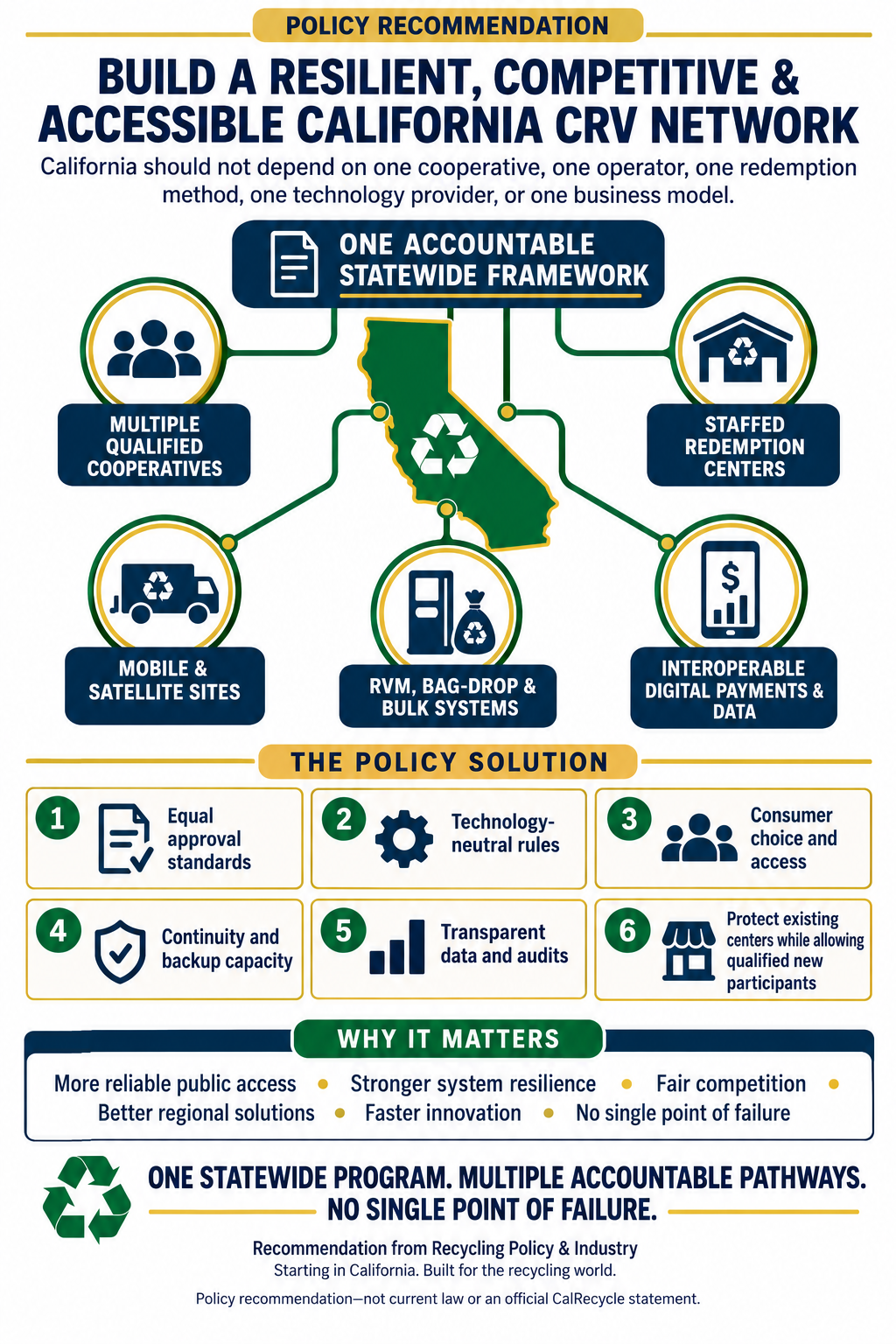
RECOMMENDATION BRIEF
One statewide program. Multiple accountable pathways.
California should not depend on one cooperative, one operator, one redemption method, one technology provider or one business model. A resilient CRV network should allow multiple qualified participants to operate under the same transparent standards.
Recommended implementation
- Apply equal standards. Use consistent approval, financial, service, audit and reporting requirements for every cooperative.
- Remain technology neutral. Allow staffed centers, mobile and satellite service, RVMs, bag-drop and bulk-return systems when each model meets measurable access and performance requirements.
- Require continuity plans. Every statewide or regional network should have backup capacity for provider failure, technology outages, disasters and sudden site closures.
- Use interoperable records. Standardize location, material, refund, payment and processor-reconciliation data so CalRecycle can compare and audit performance.
- Protect existing access. New programs should expand service and consumer choice without unnecessarily displacing reliable recycling centers.
Status: This is a Recycling Policy & Industry recommendation. It is not current law, an official CalRecycle statement or evidence of agency endorsement.
Reduce single-point risk
If one contractor, technology network or cooperative experiences disruption, another qualified network can help preserve consumer redemption access.
Fit California's regions
Dense cities, rural counties, mountain communities and desert routes need different combinations of staffed sites, mobile service, bag drop and RVMs.
Create meaningful choice
Retailers and service partners can compare coverage, reliability, technology, cost and public results instead of depending on one statewide operating model.
Accelerate better ideas
Multiple accountable organizations can test different access models while common data standards allow California to compare outcomes fairly.
Strengthen continuity
The RePlanet collapse showed how a large network loss can affect redemption access. Future systems should include backup plans before a disruption occurs.
Protect public funds
Performance-based contracts, auditable transactions and transparent funding rules can reward verified service rather than organizational size alone.
Recommended guardrails
Six tests for fair entry and accountable service
- 01Open, objective entry
Publish the same plan, financial, nonprofit, capacity, consumer-access and reporting standards for every applicant, with review milestones and written reasons for decisions.
- 02Regional service strength
Allow qualified cooperatives to specialize by region or service model while requiring complete coverage for every convenience zone included in an approved plan.
- 03Continuity and backup capacity
Require contingency plans for contractor failure, technology outages, funding disruption, disasters and sudden loss of multiple redemption sites.
- 04Interoperable records
Use common transaction, location, material, refund and processor-reconciliation fields so CalRecycle can compare performance and audit every cooperative consistently.
- 05Fair funding and accountability
Apply transparent eligibility rules for grants, handling fees and other program payments, with public reporting tied to verified containers and service delivered.
- 06Consumer and operator choice
Permit dealers to choose among qualified programs where legally and operationally feasible, without weakening refund access, existing-center viability or anti-fraud controls.
Practical impact
Who benefits from a resilient network?
More nearby redemption options, more service models and less risk that one disruption removes access across a large region.
A choice among qualified service partners, clearer performance comparisons and backup arrangements when a provider cannot serve a zone.
More contracting pathways for staffed sites, mobile service, bag drop, transportation, equipment and material handling.
More predictable regional material flows when data and reconciliation standards are consistent across programs.
Comparable performance data, reduced single-provider concentration and stronger continuity planning for statewide consumer access.
Transparent methodology
What this watch includes—and what it does not claim
Official status controls. “Approved” and “operational” come from CalRecycle's program, plan, reporting and public-notice records.
Applications stay separate. A proposal, rumor, corporate filing, grant application or planned service is not an approved stewardship plan.
Counts need dates and scope. Site totals show the exact official publication date and are not presented as real-time operating guarantees.
Recommendations are labeled. The multi-cooperative model is policy analysis by Recycling Policy & Industry, not a statement by CalRecycle.