Share this pageSend this exact page to a colleague, community member or decision-maker.
Policy desk
Legislation, rulemaking and industry positions—in one workflow.
Use the analysis to understand the issue, then verify every current status, deadline and controlling requirement at the linked official source.
Policy position · Status reviewed September 1, 2026
SB 955: Support passage—and protect California's CRV infrastructure through strong implementation.
Passed Legislature · Enrollment recorded
The Senate concurred in Assembly amendments on August 27, 39–0. The official status page lists enrollment August 30. No signature or chapter appears in the September 1 record reviewed.
California CRV Policy & Industry positionSUPPORT SB 955. Follow Governor action and implementation.
SB 955 protects important handling-fee provisions through June 30, 2032, protects eligible existing centers affected by the supermarket-threshold change, and prevents an RVM entering a convenience zone from disqualifying an existing certified recycling center from handling-fee eligibility.
Technology should supplement and strengthen certified recycling centers—not replace, weaken or destabilize them.
Implementation, oversight and future-improvement recommendations
01
Protect existing certified centers.
No new publicly supported model should cause a compliant center to lose certification, handling fees, payments, its service area or the volume needed to remain viable.
02
Require full-service RVM standards.
Measure uptime, capacity, hours, materials accepted, ADA access, payment access, customer support and overflow response before treating an RVM as adequate service.
03
Expand access without unnecessary duplication.
Approve supplemental service for documented gaps and net-new redemption—not simply to divide existing volume or weaken permanent infrastructure.
04
Preserve grandfather protection.
Existing centers should not lose handling-fee eligibility solely because the supermarket definition changes while they remain at the certified location and otherwise compliant.
05
Protect fair handling fees.
Preserve at least $0.0125 per eligible container, adjusted for inflation, or the verified cost-survey rate—whichever is greater—supported by transparent, independent cost studies.
06
Require public accountability.
Report service by model, public payments, volume changes, downtime, complaints, cost per container and whether each program produces net-new redemption.
Recommended action now
Monitor Governor action on SB 955. The six safeguards above remain recommendations for CalRecycle implementation, legislative oversight, stakeholder discussion and possible future legislation. They are not conditions of support.
Approved and chaptered September 18 as Chapter 319, Statutes of 2026. As an urgency statute it took effect immediately. A certified RVM does not make an unserved zone served, does not bar specified mobile units or dealer cooperatives from program payments, and does not by itself end an existing center’s handling-fee eligibility. The handling-fee methodology authority extends through June 30, 2032.
Approved and chaptered September 27 as Chapter 701, Statutes of 2026. The specified bag-in-box processing-fee cap concerns manufacturer processing fees, not consumer CRV or recycler payments.
Approved and chaptered September 18 as Chapter 315, Statutes of 2026. The non-urgency law raises a recycled-content penalty to $0.30 per pound and adds third-party validation and public compliance reporting beginning in 2028.
Approved and chaptered September 20 as Chapter 403, Statutes of 2026. After primary glass quality payments, CalRecycle may use remaining annual funds for qualifying clean CRV glass used in California non-container glass products, up to $30 per ton.
Approved and chaptered September 28 as Chapter 717, Statutes of 2026. It creates restrictions and penalties for covered disposable battery-embedded vapor devices.
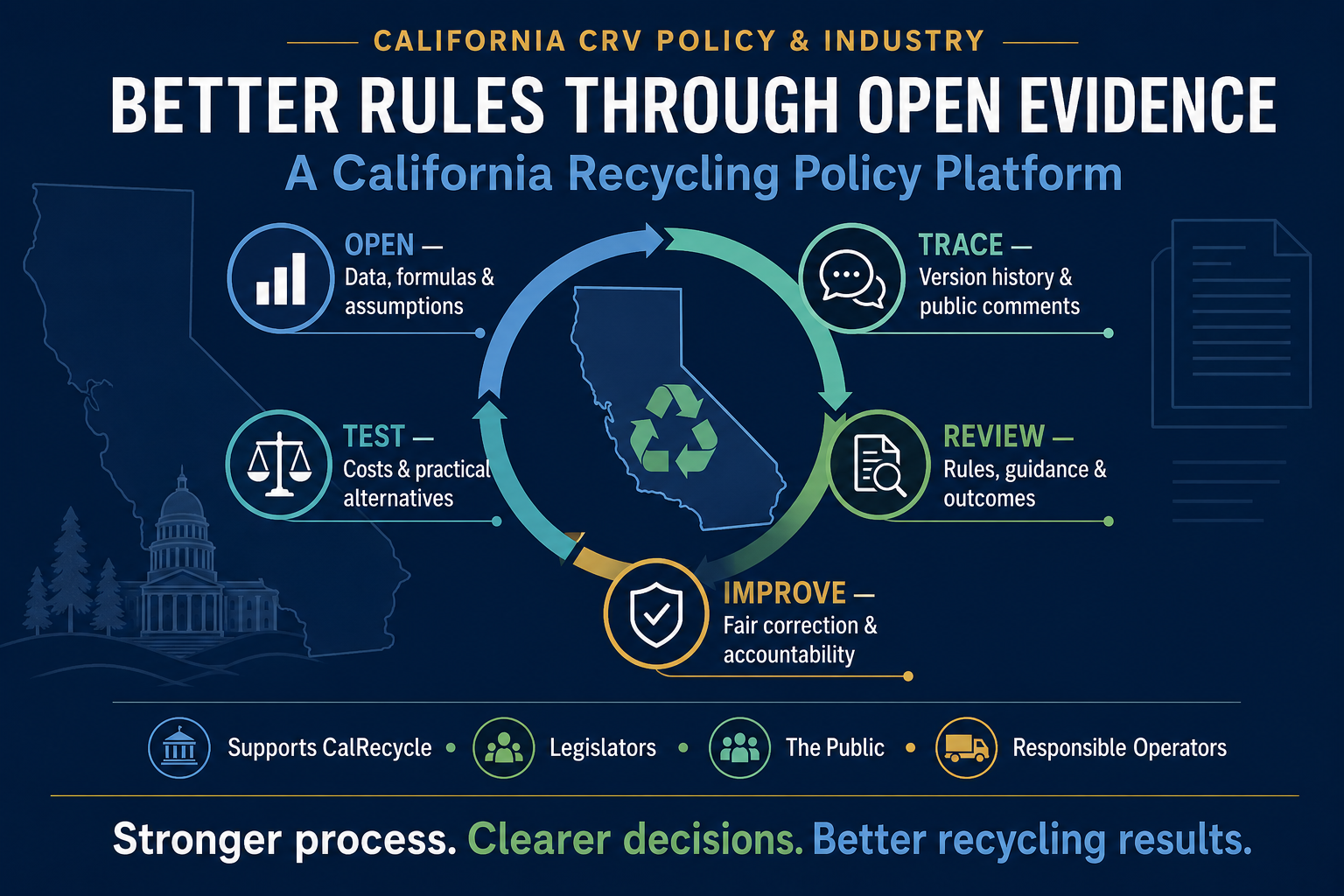
Strengthen public confidence in California recycling policy by making major rules, payment methodologies and implementation decisions easier to understand, evaluate and improve.
Approach
Build on California's existing Administrative Procedure Act and support CalRecycle with clearer evidence standards, better public participation and dependable review cycles.
Shared outcome
More durable regulations, fewer implementation disputes, stronger program performance and better results for consumers, government and responsible operators.
01
Open evidence package
Publish the data, assumptions, formulas, survey instruments, consultant work and calculations supporting every major rule, rate, cost study or payment methodology.
02
Clear version history
Maintain an accessible record of what changed, when it changed, why it changed and how the revision affects consumers, operators and public funds.
03
Traceable public comments
Assign comments a permanent reference and provide a direct, evidence-based response to each material recommendation or concern.
04
Independent cost review
Use qualified independent review for major handling-fee studies, processing-payment studies and other methodologies with significant financial consequences.
05
Alternatives testing
Compare the preferred proposal with feasible alternatives, including proposals submitted by consumers, local governments and regulated participants.
06
Lifecycle review
Review major recycling regulations and payment methodologies on a regular schedule to confirm that they remain necessary, effective and aligned with current conditions.
07
Responsible emergency rules
Preserve the ability to respond quickly while using clear expiration dates, transparent justification and timely transition to full public rulemaking.
08
Consistent public guidance
Ensure that generally applicable memoranda, manuals, bulletins and enforcement interpretations are accessible, legally grounded and consistent with adopted regulations.
09
Measurable results
State the expected effect on access, redemption, recycling volume, fraud prevention, administrative cost, compliance and recycling-center stability.
10
Accessible correction process
Provide a fair path to identify inconsistent interpretations, correct administrative errors and resolve disputes before they become larger program problems.
Designed for partnership
This proposal strengthens the process—not one side of it.
It supports CalRecycle.Better records and clearer standards help staff defend sound decisions and implement legislative direction consistently.It supports legislators.Transparent evidence and performance reporting make oversight, budgeting and statutory improvements more informed.It supports the public.Consumers can see what a policy is expected to accomplish and whether public funds are producing measurable results.It supports responsible operators.Clear expectations and dependable review reduce uncertainty while preserving strong compliance and enforcement.
California CRV modernization platform
Six practical proposals for safer payments, flexible service and accountable technology.
Policy recommendations · Not current requirements
These concepts are presented for discussion with legislators, CalRecycle, processors, recycling-center operators, technology providers and other interested stakeholders. Each proposal should be evaluated through public rulemaking, fiscal review, consumer-access analysis and appropriate privacy and security standards before implementation.
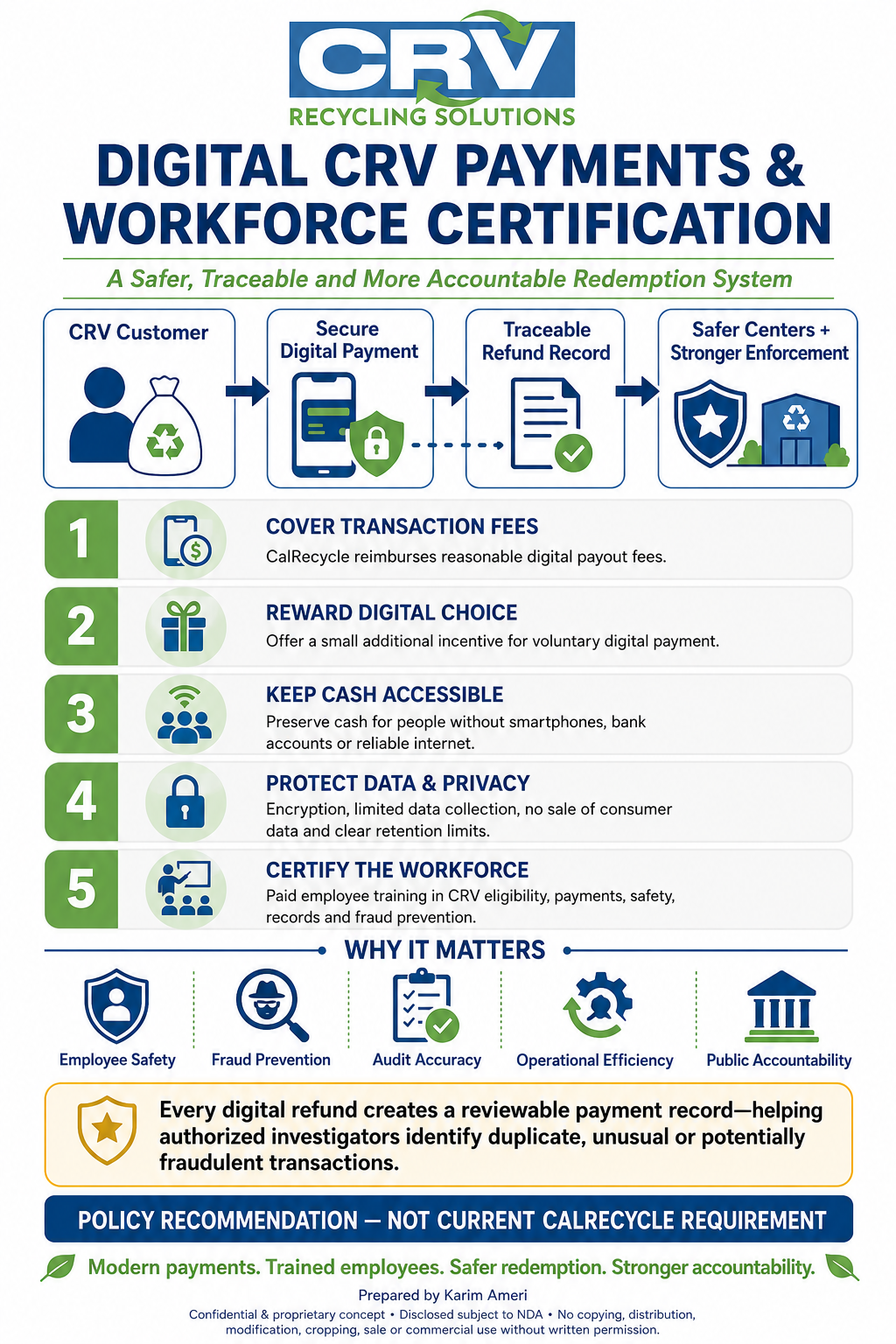
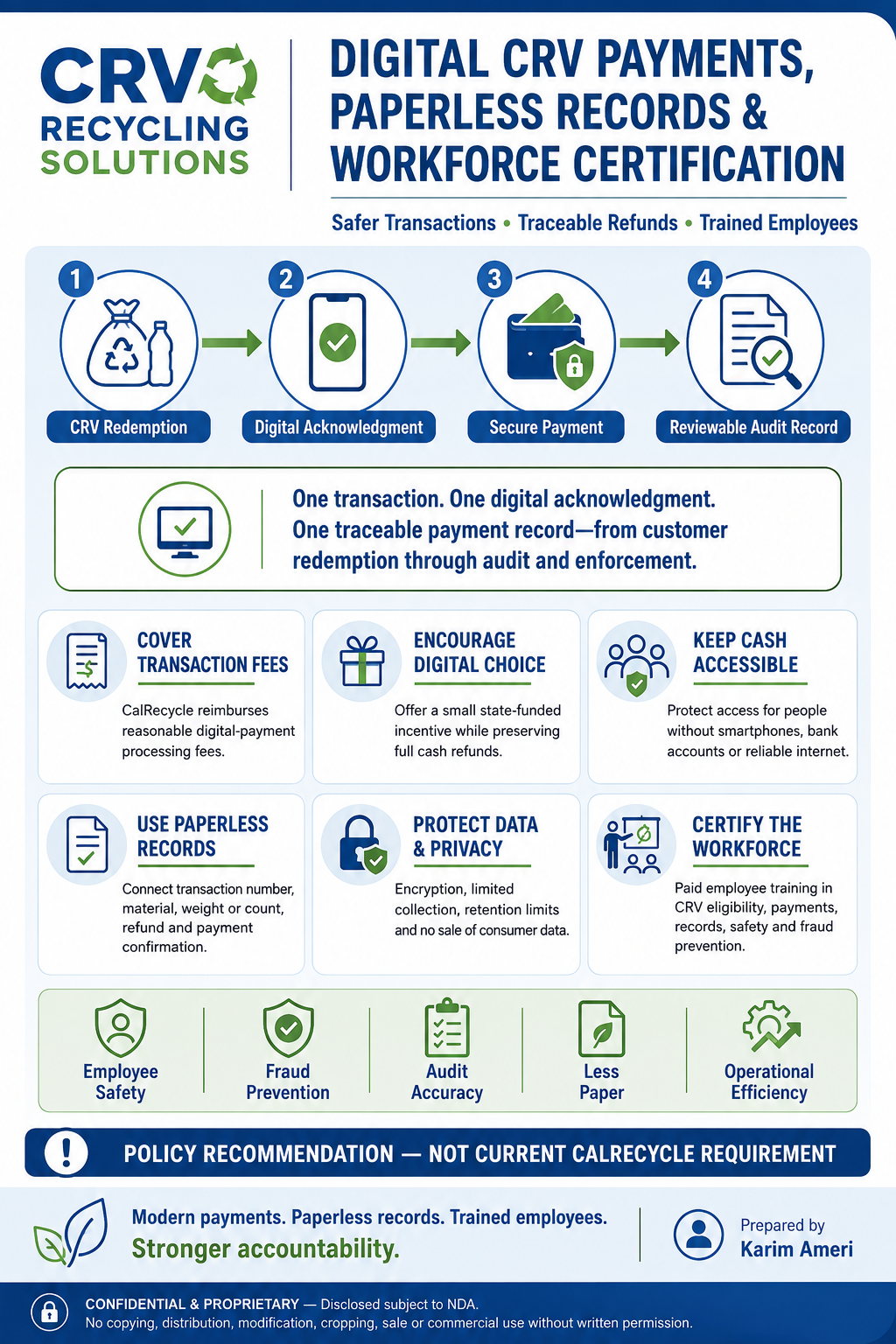
Recommendation: CalRecycle should support secure digital payout options, reimburse reasonable transaction fees, preserve a cash option and require paid, portable training for employees who handle CRV materials, payments, weighing or records.
Why it matters: A traceable payment record can reduce cash-handling risk, improve employee safety, simplify reconciliation and help authorized investigators review duplicate, unusual or potentially fraudulent transactions.
Implementation: Any program should limit data collection, prohibit commercial use of consumer information, establish cybersecurity and retention rules, and offer an accessible alternative for people without smartphones or bank accounts.
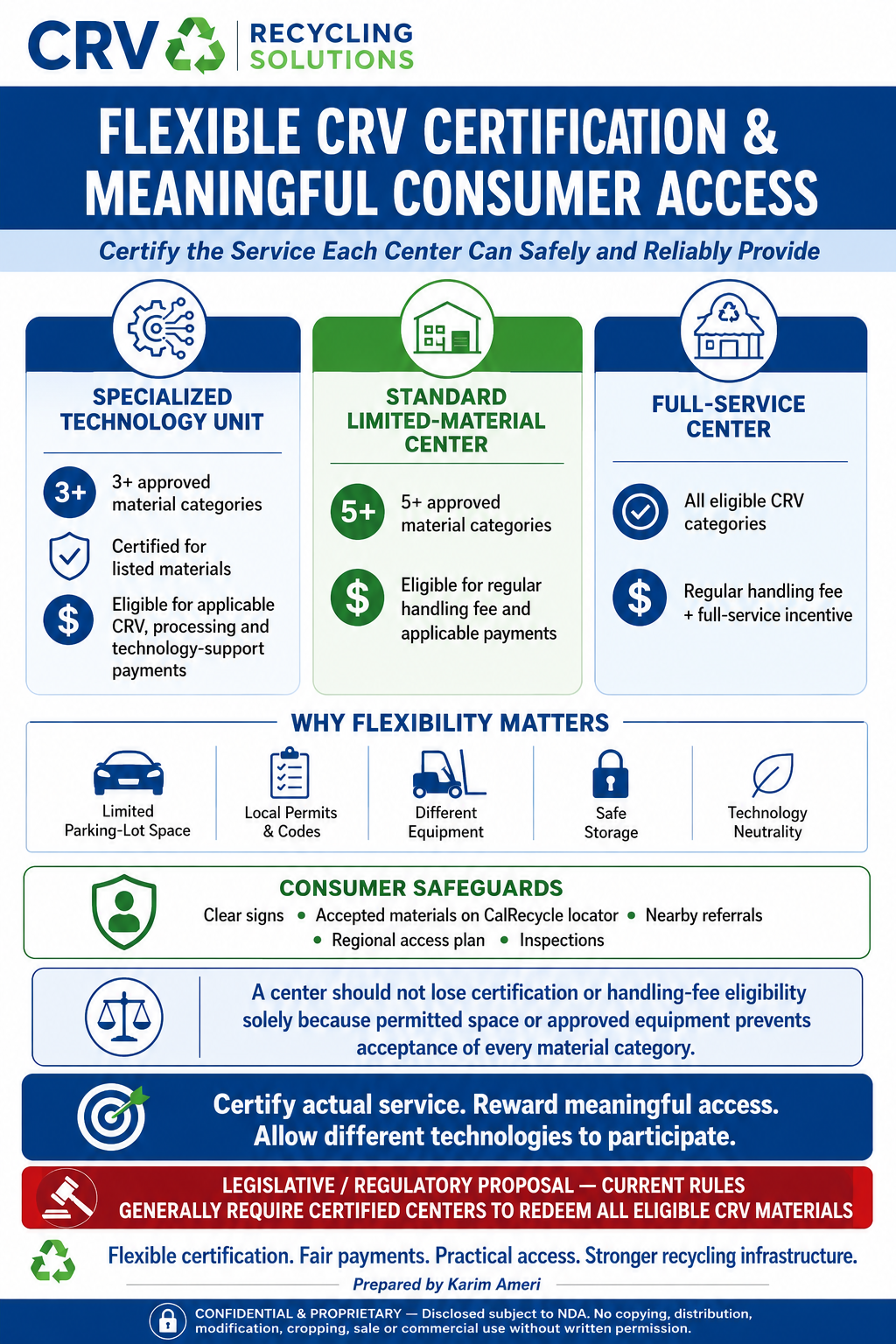
Certify the Service Each Center Can Reliably Provide
Recommendation: Establish material-based certification levels for specialized technology units, centers accepting at least five approved categories and full-service centers accepting every eligible category, with payment eligibility matched to the service delivered.
Why it matters: Parking-lot centers face real limits involving space, local permits, storage, equipment and processor access. A technology-neutral framework can expand redemption without forcing every location into the same operating model.
Consumer protection: Certificates, signs and CalRecycle's locator should identify accepted materials; regional plans and nearby referrals should preserve reasonable access for every eligible CRV container type.
One Transaction, One Digital Acknowledgment, One Audit Record
Recommendation: Authorize secure electronic signatures, digital customer acknowledgments and paperless receipts that connect the transaction number, date, location, material, weight or container count, refund amount and payment method.
Why it matters: Paperless records reduce physical storage and missing paperwork while creating a consistent link between the customer acknowledgment, refund calculation and completed payment.
Safeguards: Records should be tamper-resistant, accessible for the required retention period, available for authorized audits and printable or downloadable by the customer. An alternative must remain available for anyone unable to use a touchscreen or digital account.
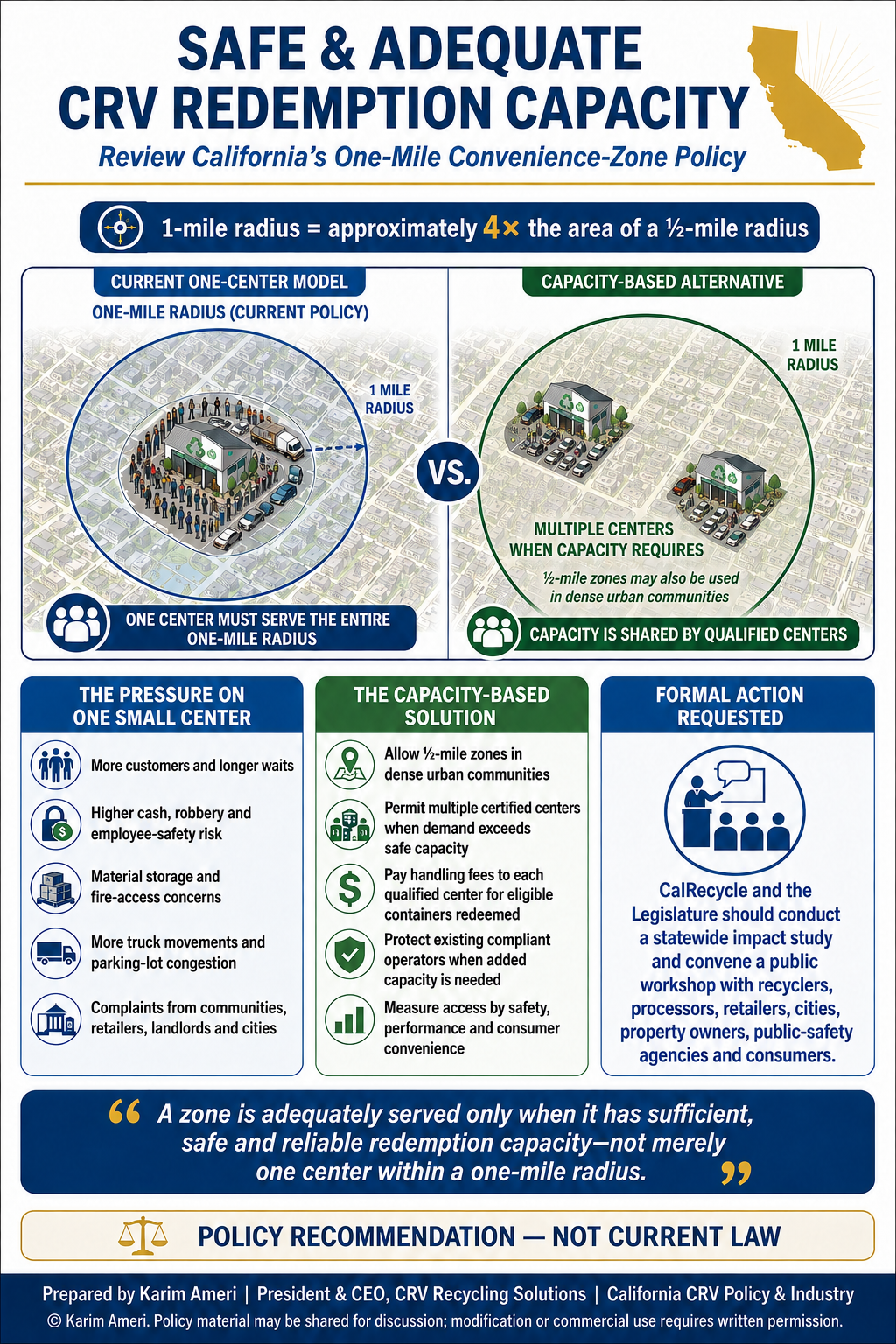
Measure Whether a CRV Zone Has Enough Capacity—not Merely Whether One Center Exists
The concern: A one-mile-radius zone covers approximately four times the area of a half-mile-radius zone. Treating one certified center as sufficient can concentrate customers, containers, cash, storage and truck movements at a small supermarket-site operation, particularly where one location also serves overlapping zones.
Why it matters: Many parking-lot centers operate within approximately 500–600 square feet. Excessive concentration may contribute to longer waits, cash and robbery exposure, employee-safety concerns, material accumulation, fire-access issues, frequent pickups, parking-lot congestion and complaints from communities, retailers, landlords and cities. These are credible operational risks that should be tested through statewide data—not presented as proven consequences at every location.
Recommendation: Allow half-mile zones in dense urban communities and authorize multiple handling-fee-eligible centers within a one-mile zone when population, redemption volume, waiting time, overlapping zones, permitted storage, truck activity or documented safety conditions demonstrate that additional capacity is necessary.
Operator protection: A compliant existing center should not lose handling-fee eligibility merely because another qualified center is approved to address unmet demand. Each approved center should receive applicable handling fees for the eligible containers it actually redeems, subject to normal reporting, inspection and fraud controls.
Action requested: CalRecycle and the Legislature should conduct a statewide impact study and convene a public workshop with recyclers, processors, retailers, local governments, property owners, public-safety agencies and consumers.
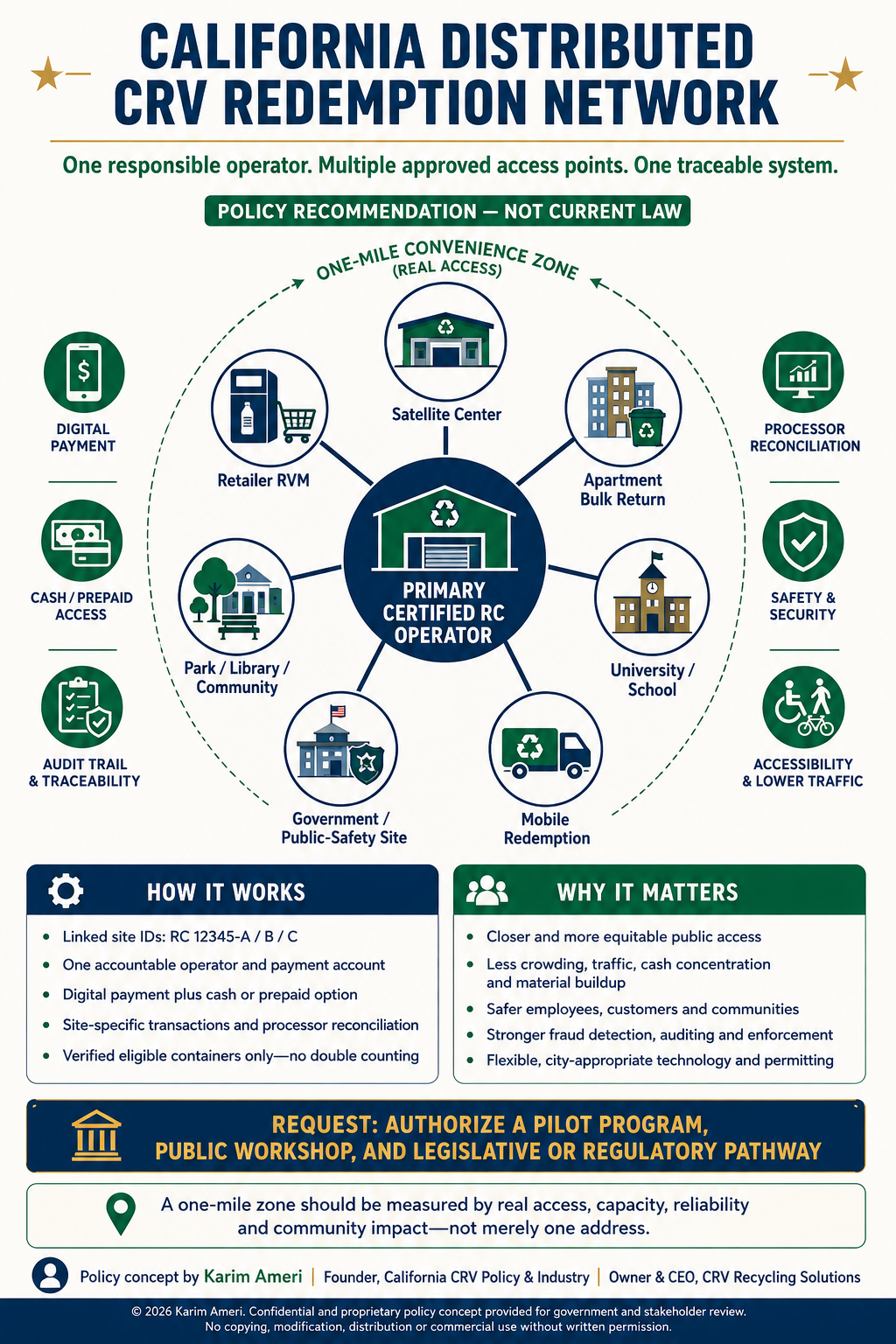
One Responsible Operator. Multiple Approved Access Points. One Traceable System.
The concern: California’s one-mile convenience-zone structure can require one small recycling center to serve a large population. Customers, vehicles, materials, cash transactions and transportation activity can become concentrated at one address, contributing to overcrowding, service limitations, safety concerns and community complaints.
Recommendation: Allow one accountable certified recycling-center operator to provide multiple CalRecycle-approved access points within the same one-mile zone. Approved options could include staffed satellite locations, reverse vending machines, automated bulk-return or bag-drop systems, mobile redemption units and secure digital-payment technology.
Community placement: Where appropriate and locally permitted, access points could serve retailers, apartment communities, parks, libraries, schools, universities, transit locations and government properties. Placement should respond to population, walking and driving access, site capacity, safety and demonstrated redemption demand.
Traceability and enforcement: Each access point would receive a unique identification number linked to the primary RC certification. Transactions would be recorded by location, material, weight or count, refund amount and payment method, then reconciled with processor deliveries. This structure can strengthen auditing, identify inconsistencies and prevent duplicate claims.
Operator responsibility: The primary certified operator would remain responsible for compliance throughout the network. Applicable payments would be based only on verified eligible containers. Digital payments could be offered while preserving cash or prepaid-card access for consumers who do not use smartphones or traditional bank accounts.
Action requested: Conduct a formal policy and legal review; schedule a public CalRecycle workshop; establish a limited pilot with willing cities and operators; identify necessary statutory and regulatory changes; and consider legislation authorizing the distributed model.
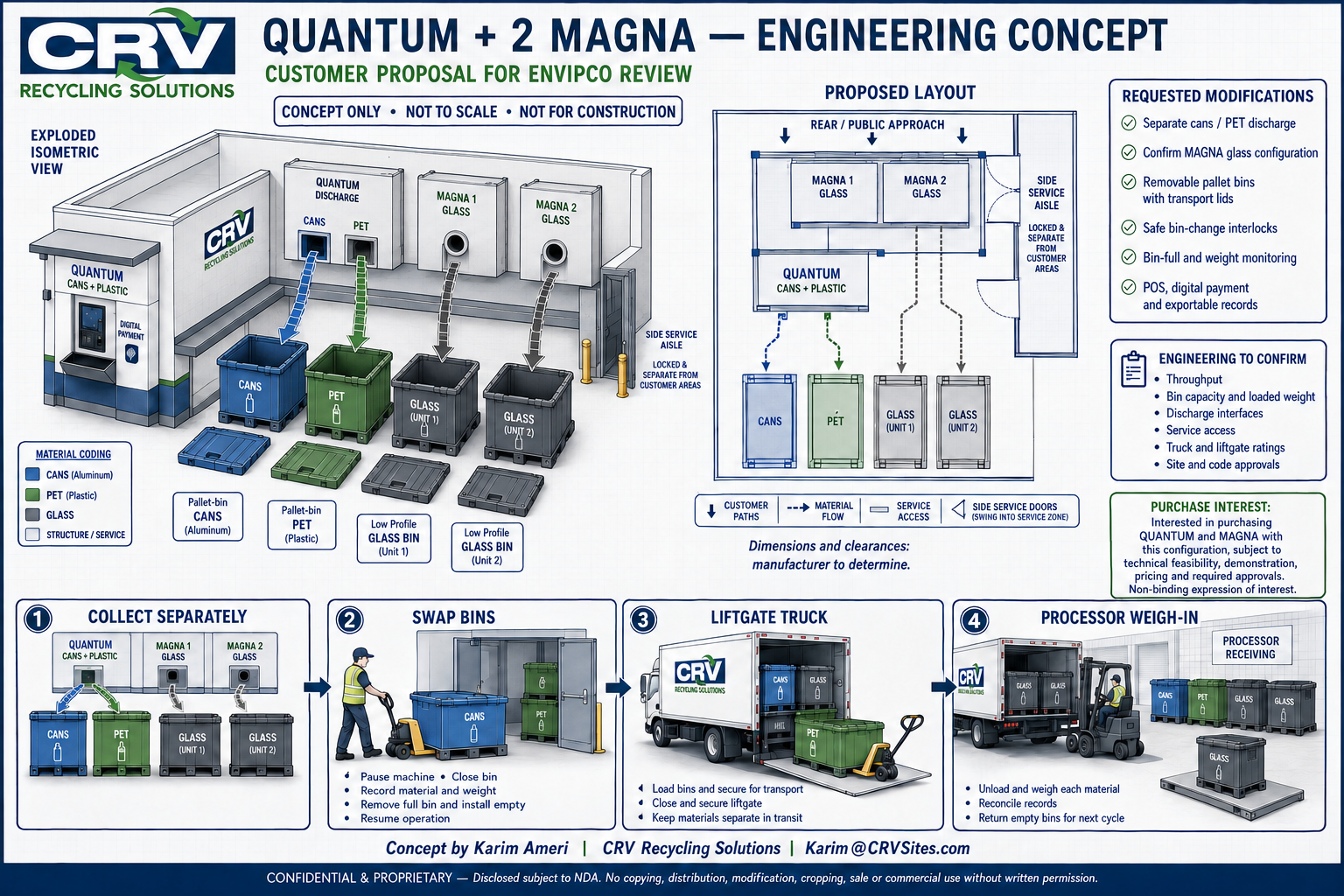
Quantum + Two Magna: A Specialized Multi-Material Service Model
Recommendation: CalRecycle should create a technology-neutral certification pathway allowing approved systems to redeem the material categories they can safely separate, document and transfer to processors. A specialized unit should be eligible for applicable program payments when it produces verified consumer access and compliant material records.
How the concept works: The proposed layout separates cans, PET and two glass streams into removable pallet bins, records material and weight, closes each bin for transport and keeps materials separated through processor weigh-in and reconciliation.
Next review: The manufacturer, operator, processor and permitting agencies must confirm throughput, bin capacity, loaded weight, discharge interfaces, service access, truck and liftgate ratings, safety controls, site approvals and integration with digital payment and exportable records.
Combined policy direction
Modern payments. Paperless records. Trained employees. Flexible certification. Adequate capacity. Safer redemption. Stronger accountability.
Recommended legislative path
Build the proposal carefully, in four practical steps.
01
Map the current California framework
Identify the protections already provided by the APA, OAL review and program-specific statutes so the proposal adds value without duplication.
02
Identify recycling-specific gaps
Focus on cost studies, payment methodologies, emergency rules, generally applicable guidance, grant criteria and implementation performance.
03
Draft neutral statutory language
Use standards that apply consistently and preserve necessary agency discretion while requiring transparent evidence and reasoned decisions.
04
Convene a balanced working group
Invite CalRecycle, OAL, legislative staff, consumer representatives, local government, recyclers, processors, dealers and environmental organizations.
Proposed policy statement
Public authority is strongest when decisions are supported by open evidence, transparent reasoning, meaningful participation and measurable results.