Clear zoning authorization
Identify commercial zones where CRV redemption facilities may operate.
Reads visible page information. Voice choices depend on your device; choosing a voice does not translate the text.
 Recycling Policy & IndustrySearch • Policy • Industry • Action
Statewide policy initiative
No statewide audit or petition has been launched. City experiences will be published as verified case studies—not as findings of misconduct.
Follow Thursday updates →Why this matters
Operators report unclear zoning rules, inadequate designated space, inconsistent planning interpretations, costly conditional-use permits and lengthy review processes. Small operators may lack the time, funding and legal support needed to pursue a viable location.
Local concerns involving traffic, appearance, noise, illegal dumping, graffiti and safety deserve reasonable operating standards. The goal is not to remove local oversight—it is to make that oversight clear, objective, timely and consistent with statewide recycling responsibilities.
California should not require redemption access at the state level while unclear local permitting prevents that access from being built.
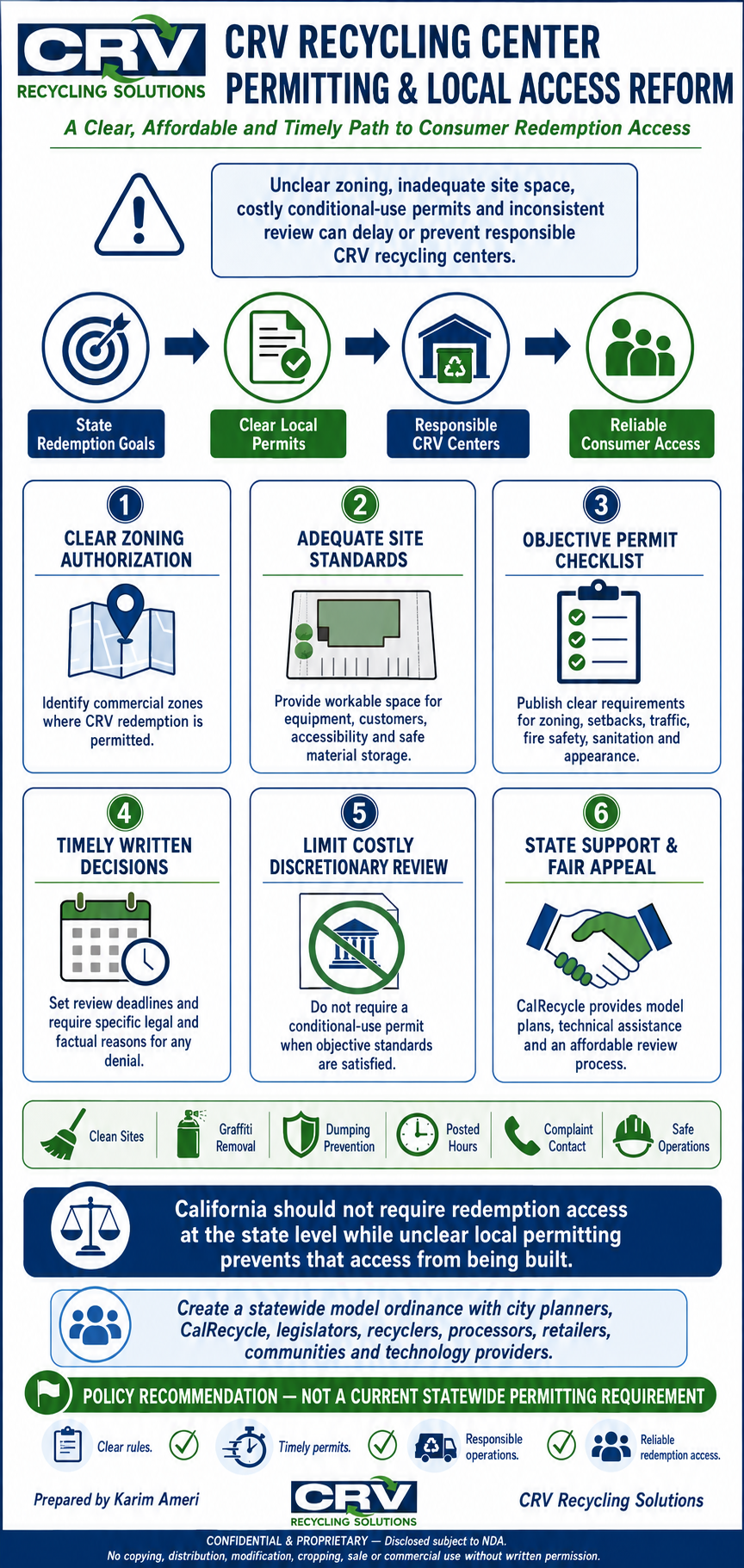
Requested reforms
Identify commercial zones where CRV redemption facilities may operate.
Provide workable space for equipment, accessibility, customers and safe storage.
Publish requirements for zoning, setbacks, traffic, fire safety, sanitation and appearance.
Set review deadlines and provide specific legal and factual reasons for a denial.
Avoid costly discretionary review when a project satisfies objective standards.
Provide model plans, technical assistance and an affordable review process.
Campaign roadmap
Establish the statewide objective, policy principles and evidence standards.
Build complete city case files and a comparable permitting-barrier table.
Evaluate delay, cost, abandoned investment, jobs and consumer-access effects.
Obtain focused land-use and planning analysis before making legal conclusions.
Build a balanced coalition of operators, processors, retailers, cities and consumers.
Request a statewide survey, working group, model plans and a model ordinance.
Seek oversight, statutory solutions and a focused performance-audit request.
Launch a petition and public campaign only after the evidence record is ready.
Case-study program
Accountability path
Request statewide permitting data, an access-gap analysis, a working group and model local standards.
Present verified evidence and request hearings, statutory reform and implementation funding.
Examine CalRecycle and a representative sample of cities rather than alleging wrongdoing statewide without evidence.
Ask for a specific model ordinance and minimum standards supported by documented cases.